 Czechia
UEFA · Europe
Czechia
Lvíčata · The Lions
With two World Cup final appearances as Czechoslovakia, a European Championship triumph in 1976 — featuring one of football's most famous penalties — and stars like Nedvěd and Čech, Czech football has a remarkable heritage.

🎵Hello, I am Lin!
Hello! I am Lin! Did you know that in 1976, Antonín Panenka scored one of the most famous penalties in football history — chipping it gently down the middle while the goalkeeper dived — to win the European Championship? That move is now called a 'Panenka' everywhere in the world!
Quick Facts
Football Association Founded
FAČR — as Czechoslovakia from 1901, Czech FA formed 1993
Country Timeline
Czechoslovakia (1918–1992) → Czech Republic → Czechia (official since 2016)
Nickname
Lvíčata — The Lions — representing strength and national pride
Home Stadium
Fortuna Arena (Sinobo Stadium), Prague — capacity 19,370
FIFA Confederation
UEFA — Union of European Football Associations
Domestic League
Czech First League — highly competitive league, known for developing players
Discover Czechia
Czechia — also known as the Czech Republic — is a landlocked country in the heart of Central Europe, bordered by Germany, Austria, Slovakia, and Poland. It is a country of rolling hills, deep forests, medieval castles, and picturesque towns. The landscape is dominated by the Bohemian Basin in the west, the Moravian lowlands in the east, and the Sudeten and Giant Mountains along the northern borders.
Prague, the capital, is one of Europe's most stunning and best-preserved medieval cities. Its historic centre — a UNESCO World Heritage Site — features Gothic cathedrals, Baroque palaces, and the famous Charles Bridge spanning the Vltava River. Czechia is the world's largest per capita consumer of beer, and Czech pilsner — invented in the city of Plzeň in 1842 — is the most widely drunk style of beer in the world.
With a population of around 11 million people, Czechia is a prosperous and stable democracy at the heart of Europe. It has one of the lowest unemployment rates in the European Union and a highly skilled workforce. The country is known for its engineering excellence — producing Škoda cars, Bohemian crystal glassware, and world-renowned classical music composers including Antonín Dvořák and Bedřich Smetana. Football is the most popular sport and a source of national pride.
Map of Czechia

🌍 Where in the World
Flag of Czechia
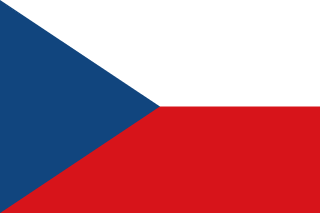
Czechia's flag features two equal horizontal bands of white (top) and red, with a blue triangle extending from the left side. The white and red colours come from the ancient coat of arms of Bohemia, while the blue triangle was added when Czechoslovakia was formed in 1918 to incorporate the colours of Moravia and Slovakia.
🏟️ A Century of Czech & Czechoslovak Football
The football history of Czechia spans more than a century and two different national identities. As Czechoslovakia, the team was a major force in the early decades of world football — reaching the World Cup final twice in 1934 (losing to Italy) and 1962 (losing to Brazil). The 1934 team featured the remarkable Oldřich Nejedlý, who finished as the tournament's top scorer.
The greatest moment came at the 1976 UEFA European Championship in Yugoslavia — Czechoslovakia, as the nation was then known, won the tournament on penalties against West Germany. The decisive penalty was taken by Antonín Panenka, who — with extraordinary coolness — chipped the ball gently down the centre as goalkeeper Sepp Maier dived. That audacious technique, now universally known as a "Panenka," has been copied by players from Zinedine Zidane to Lionel Messi in the decades since.
After the peaceful split of Czechoslovakia in 1993, the Czech Republic quickly established themselves as a major European football nation. Finishing runners-up at Euro 1996 in England was a stunning achievement for the newly independent team. Legends like Pavel Nedvěd — who won the Ballon d'Or in 2003 — Petr Čech and Tomáš Rosický brought enormous prestige to the Czech game, and Patrik Schick carried that tradition forward into the 2020s with spectacular goals at Euro 2020.
Key Results
- 1934🥈 World Cup Runner-up (Czechoslovakia)
- 1962🥈 World Cup Runner-up (Czechoslovakia)
- 1976🏆 UEFA European Championship Winners
- 1996🥈 UEFA European Championship Runner-up
- 2004🔵 Euro Quarter-finals
- 2021🔵 Euro Quarter-finals
1976
Year of Czechoslovakia's greatest triumph — European Champions, with the iconic Panenka penalty
✨ Did You Know?
The Panenka Penalty
In the final penalty shootout of the 1976 European Championship, Antonín Panenka coolly chipped the ball down the centre while West Germany's goalkeeper Sepp Maier dived. It was so audacious that the move is now called a 'Panenka' worldwide — used by Zidane, Messi and countless others.
Two World Cup Finals
As Czechoslovakia, Czech football reached the World Cup final twice — in 1934 (losing to Italy 2-1) and 1962 (losing to Brazil 3-1). These remain among the greatest achievements in Central European football history, showing a tradition of excellence that still inspires Czech football today.
Patrik Schick's Wonder Goal
At UEFA Euro 2020, Patrik Schick scored one of the great tournament goals — a stunning 49-metre lob over the Scotland goalkeeper from the halfway line that became an instant classic. It was voted Goal of the Tournament and reminded the world of Czech football's quality.
Want more football country details?
Full country pages in the app include Famous Players, Recent Events, and interactive quiz content. Log in to unlock the complete football experience.
Teachers Only
Bring the World Cup Quest into class

Explore More Football Nations
From the Panenka to Nedvěd's Ballon d'Or, from two World Cup finals to Schick's wonder goal — Czech football has a remarkable story. With a talented new generation, the Lions are hunting another great chapter.